Man Enough / Development notes
Bringing the DOS CD edition back to the browser.
A browser home for the supplied English v1.10 edition of Man Enough, preserving the original DOS program and its two-CD content.
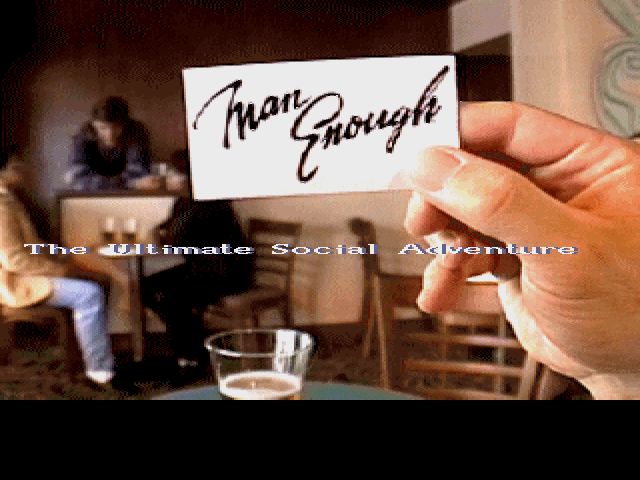
The edition
The supplied archive contains an installed copy of the English DOS game and two CD images. The original archive and disc-image bytes are retained as source material. Browser packaging is built separately so the preserved inputs remain unchanged.
Both CDs are served as unchanged ISO images. The browser reads small portions as the game needs them, rather than downloading both complete discs before it can begin. The small launch package holds the installed DOS files and drive configuration.
The player uses DOSBox-X compiled for the browser to execute the original DOS program. This release restores access to the original game; it does not introduce a new implementation of the game’s story or logic.
The browser experience
The new landing page leads to a dedicated player. Start gives the browser the user interaction it needs for audio, and the game remains a desktop mouse-and-keyboard experience. Click inside the screen for mouse input and keep the keyboard available for text and game shortcuts. A local save namespace and export/import controls keep this edition’s browser data separate from other games.
Version 1.1.0 corrects the browser audio route so the volume control changes the sound that actually reaches the output. Sound starts at 2400% and adjusts from 100–4000%. A compressor and final peak ceiling control louder moments. The original speech, music and disc bytes remain unchanged. At 100%, the player applies no requested gain boost; peak processing remains active.
Save-file storage and a successful in-game save/reopen/load cycle are different checks. Exporting a backup does not by itself prove that the game can load it, and browser storage can be cleared. Use the recorded results below when deciding how to keep progress.
Verification
The release and preservation record binds the published files to their source identities and records the completed checks and remaining limits.
November 2, 2026 · Version 1.0.1. At Start, the player now resamples the emulator’s current visibility state. This prevents a page loaded in the background from retaining a stale pause after it becomes visible. A fresh in-app browser test reached the original cafe opening video without a foreground reload. Original media, runtime files and save handling are unchanged.
November 2 update · Sound and the media archive
Version 1.1.0. The earlier volume check verified the control values but missed the active audio worklet, which sent sound directly to the output and bypassed the boost. This update selects the pinned library’s existing controlled audio path. The path uses a 2048-frame main-thread buffer; it may be more sensitive to a busy browser than an audio worklet.
A sampled opening test at 24× measured raw audio around −45.85 dBFS RMS and processed output around −17.61 dBFS RMS. The final ceiling held the sampled peak to 0.95 (about −0.45 dBFS). The original recordings are very quiet. Mute was checked against the actual output signal, separately from the button label. These opening tests do not cover every later scene or constitute a listening test on every speaker.
The new music, sounds and images archive contains six substantial music arrangements, one separately listed sequenced cue, and 3,099 distinct digitized sound clips covering all 3,159 physical PCM chunks found in the supplied resources. The original clips have no reliable names: voices, sound effects and other samples are grouped together, with resource IDs and every source alias retained.
The music player uses General MIDI renditions of the original sequences, rendered with FluidSynth 2.4.6 and GeneralUser GS 2.0.3. These are documented browser listening derivatives rather than recordings of the game’s original sound hardware. Converted MIDI files are also available. Sampled sounds retain their original unsigned 8-bit PCM and native sample rates in WAV containers.
The image gallery contains 1,594 distinct indexed PNGs representing 1,774 source image references: all 1,613 stored still resources, 146 sprite frames, the assembled installer bitmap and 14 font contact sheets. Original pixel indices and palette records are retained. The 128,000-pixel stills are arranged as 320×400 storage previews; their original display layout and aspect ratio have not yet been verified. Font contact sheets use a labeled neutral preview palette.
The archive inventories 1,074 animation and video resources separately. These remain on the unchanged CDs and are not expanded into individual video frames in the still-image gallery. The extraction sources, pinned decoder references, rendering recipe and notices are included with the media record. Exact duplicate resources share one derivative while retaining their original identifiers.
Keeping the collection intact
This update is limited to the Man Enough project and this dated note. Existing games and older development notes are retained. The game is listed with PC and computer projects, while the original DOS edition remains clearly identified. The preservation guide describes the source inputs, runtime and release workflow.